America's refining system is already operating with very little margin for error.
Across much of the country, refineries have been running at or near full capacity for months. When a refinery experiences an unexpected outage, a major maintenance event, or a Gulf Coast hurricane disrupts operations, fuel supplies can tighten quickly and prices rise.
That vulnerability has grown as the United States has steadily lost refining capacity over the past decade. Every refinery closure leaves less flexibility in the system, making fuel markets more susceptible to supply disruptions and price volatility.
At the same time, policymakers are considering expanding year-round E15 sales without addressing longstanding structural flaws within the Renewable Fuel Standard (RFS). Without broader reforms, that approach could increase ethanol mandates and further raise already significant compliance costs for independent refiners.
Lawmakers looking for the potential consequences of that path need only look west.
California's Warning
California demonstrates what can happen when fuel policies continually increase regulatory costs while refining capacity declines.
Over the past several years, the state has layered multiple fuel regulations and compliance programs onto its transportation fuel market. During that same period, California has lost roughly 20 percent of its refining capacity since 2019, reducing in-state production and leaving the market increasingly dependent on outside supply.
Today, California imports an estimated 250,000 to 300,000 barrels of gasoline per day from foreign refineries to help meet demand. Meanwhile, California drivers routinely pay some of the highest gasoline prices in the nation.
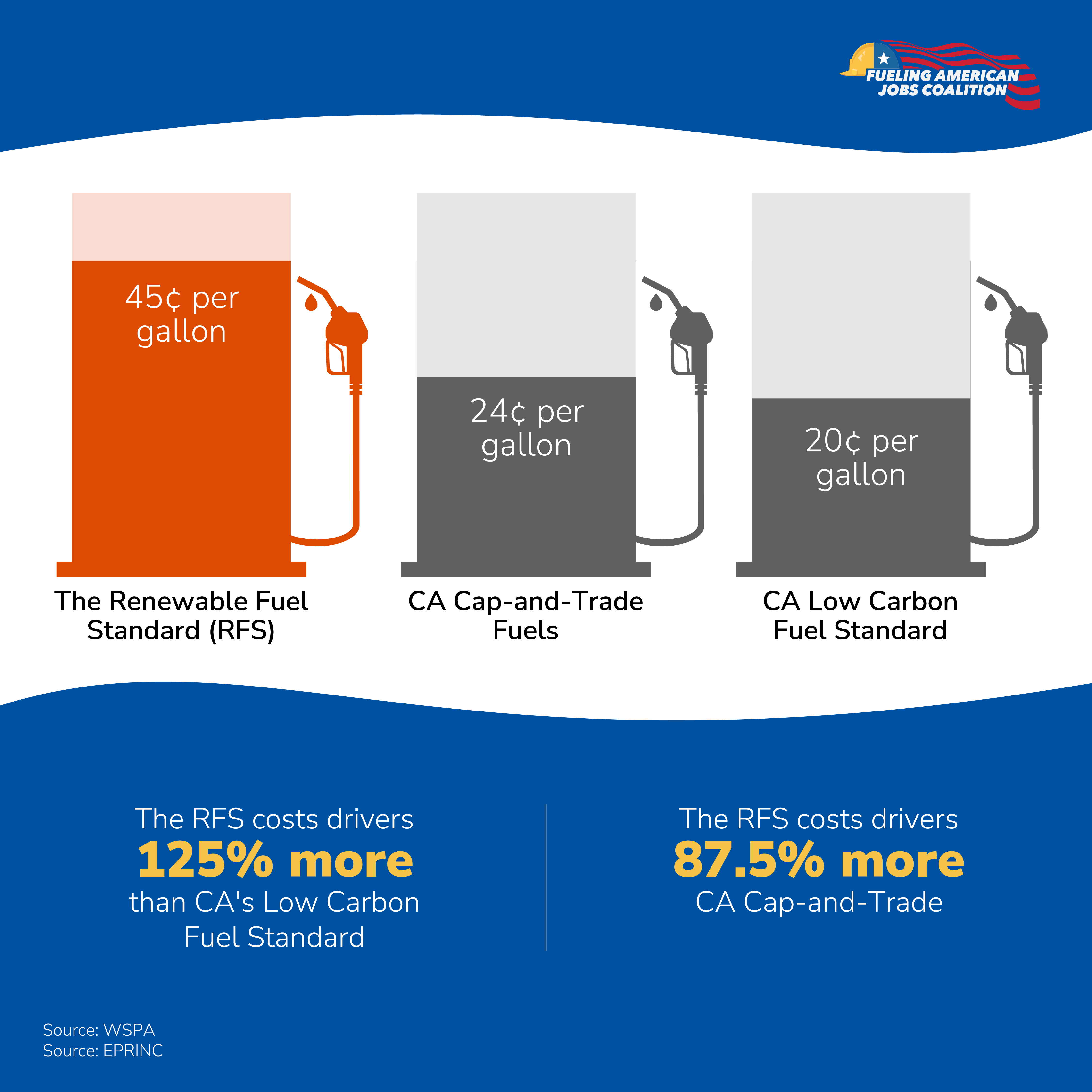
While many factors influence gasoline prices, state fuel policies play a meaningful role. California's Low Carbon Fuel Standard (LCFS) is estimated to add roughly 20 cents per gallon, while the state's cap-and-trade program adds an estimated 24 cents per gallon to fuel costs.
By comparison, the RFS consistently adds more than 30 cents per gallon to fuel costs. Some current estimates place nationwide RFS compliance costs at approximately 45 cents per gallon, exceeding the combined estimated cost of California's LCFS and cap-and-trade program.
Independent refiners are already facing unprecedented compliance costs. Because many lack ethanol blending infrastructure, they must purchase Renewable Identification Numbers (RINs) to satisfy federal requirements, leaving them especially exposed to rising compliance costs. Expanding year-round E15 without meaningful RFS reform could increase ethanol mandates and further raise those costs, putting additional financial pressure on independent refiners and increasing the risk of refinery closures.
The result would be a refining system with less capacity, greater dependence on imported fuels, and fewer safeguards against fuel price spikes, precisely the vulnerabilities California has experienced.
There's a Better Path: Commonsense RFS Reform
The solution is not eliminating biofuels. It is modernizing the Renewable Fuel Standard so that federal policy reflects today's fuel market and infrastructure realities. Congress and federal regulators should prioritize:
-
Achievable annual volume requirements
-
Greater certainty for refiners making long-term investments
-
Policies that expand consumer choice without imposing unworkable mandates.
-
Preservation of critical refinery protections that help maintain domestic fuel supplies.
-
Reforms that protect workers, consumers, and U.S. energy security.
Bottom line: Passing unchecked E15 expansion – and allowing compliance costs to keep piling up – will have consequences.
California offers a clear warning about the cumulative impact of policies that continually increase fuel-system costs while reducing domestic refining capacity.
Increasing compliance costs through unchecked E15 expansion, without meaningful RFS reform, risks weakening domestic refining capacity, increasing dependence on imported fuel, and raising prices for American consumers.
Independent refiners are essential to America's fuel supply, producing the gasoline, diesel, and jet fuel that power the economy every day. As California has shown, once refining capacity is lost, rebuilding it is extraordinarily difficult. Federal fuel policy should strengthen, not weaken, the domestic refining system that underpins America's energy security.